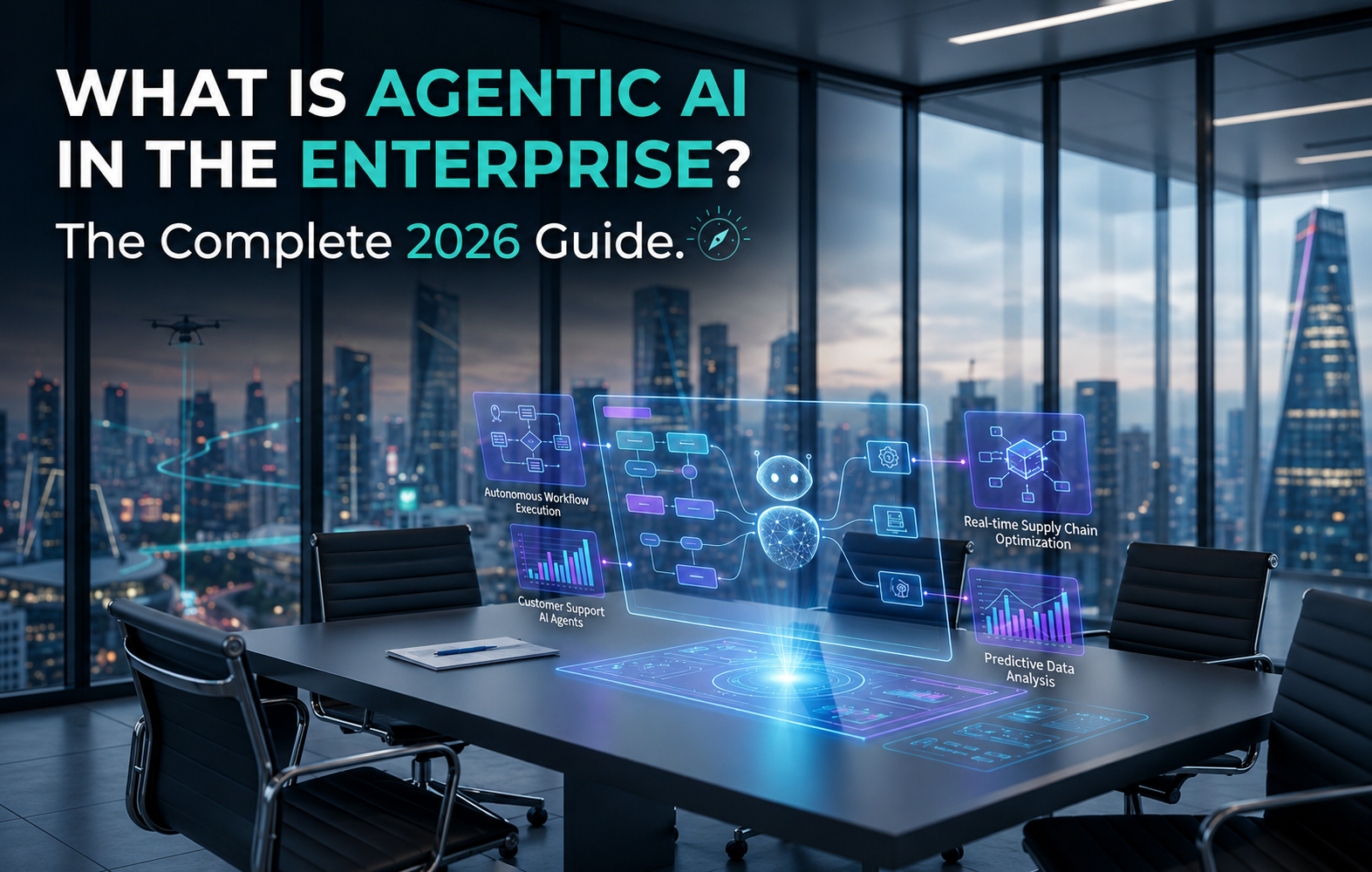

If you’ve sat through a vendor pitch in the last year, you’ve probably heard the term “agentic AI” more times than you can count. Every roadmap slide seems to have it. Every analyst report mentions it. And yet, when you ask three different vendors what it actually means, you’ll likely get three different answers.
That confusion is a problem when you’re the one responsible for budget, security, and uptime.
This guide breaks down agentic AI in plain terms, shows how it’s actually being used inside enterprises right now, and gives you a clear framework for deciding whether your organization is ready for it. No hype, no buzzword soup just what you need to make a sound decision in 2026.
What Is Agentic AI? A Plain-English Definition
Agentic AI refers to AI systems that can plan a sequence of steps, take actions through software tools, check their own results, and adjust course largely without a human approving every single step.
Think of the difference between a calculator and an assistant. A calculator gives you an answer when you ask. An assistant, on the other hand, can be told “get this done” and will figure out the steps, use the tools available, and report back when it’s finished looping in a human only when something is unclear or risky.
That second behavior working toward a goal across multiple steps, using tools, and adapting along the way is what people mean when they say “agentic.”
In an enterprise setting, this might look like an AI system that receives a ticket, pulls logs from three different systems, identifies the root cause, drafts a fix, and only pings a human engineer for final approval before deploying it.
Agentic AI vs. Generative AI vs. RPA: What’s the Real Difference
This is where a lot of IT leaders get tripped up, partly because vendors blur these lines on purpose.
Generative AI Knows Things and Produces Content
Generative AI the kind behind most chatbots is excellent at producing text, code, summaries, or images based on a prompt. But on its own, it doesn’t take action in your systems. It answers; it doesn’t execute.
RPA Follows Fixed Rules
Robotic process automation has been part of enterprise IT for over a decade. It’s powerful, but rigid. RPA bots follow a pre-defined script: if the invoice field looks like X, do Y. The moment something unexpected happens a new form layout, a missing field the bot breaks and waits for a human to fix the script.
Agentic AI Decides and Acts
Agentic AI sits a layer above both. It can use a generative model to reason about a problem, decide which tool or API to call, execute that action, evaluate whether it worked, and try a different approach if it didn’t. It’s not following a fixed script it’s working out the script as it goes, within boundaries you set.
This is the core distinction that matters for budget and risk conversations: agentic systems make decisions, which means they need different governance than tools that only generate content or only follow scripts.
How Agentic AI Works Inside an Enterprise Stack
Underneath the marketing language, most enterprise-grade agentic AI systems share a similar architecture. Understanding these pieces helps you ask sharper questions during vendor evaluations.
Goal and Planning Layer
This is where the system breaks a broad instruction (“resolve this customer billing dispute”) into smaller, ordered steps. A capable planning layer can re-order or skip steps when new information comes in, rather than rigidly following a checklist.
Tool and API Integration
An agent is only as useful as the systems it can reach. This layer connects the AI to your CRM, ticketing system, cloud console, identity provider, or internal APIs. The quality and security of these connectors often matters more than the underlying model itself.
Memory and Context
Enterprise agents need to remember relevant context prior tickets, account history, company policy without re-reading your entire knowledge base every time. Good memory design keeps responses consistent and reduces the chance of the agent repeating mistakes.
Guardrails and Human Oversight
This is the layer CIOs and security teams should care about most. It defines what the agent is allowed to do on its own, what requires human sign-off, and what’s off-limits entirely. Mature platforms let you set these boundaries per department, per data sensitivity level, or per dollar amount.
Real-World Use Cases of Agentic AI in Enterprise
Theory is useful, but most IT leaders want to know: where is this actually paying off today?
IT Operations and Helpdesk Automation
Instead of a chatbot that just points users to a help article, an agentic system can reset a password, provision software access, or restart a failed service then close the ticket and log what it did for audit purposes. Tier-1 ticket volume is one of the clearest early wins because the actions involved are repetitive and well-documented.
Cybersecurity Threat Response
Security operations centers are drowning in alerts. Agentic AI can triage incoming alerts, correlate them across endpoint, network, and identity logs, and either auto-contain low-risk incidents or escalate high-risk ones with a full investigation summary already attached. This doesn’t replace your SOC analysts it gives them a head start instead of a blank queue.
Cloud Infrastructure Management
Agents can monitor cost anomalies, right-size underused compute instances, or roll back a deployment that’s causing error-rate spikes actions that used to require someone watching a dashboard at 2 a.m.
Finance and Procurement Workflows
Three-way invoice matching, vendor onboarding checks, and purchase order approvals are full of small decisions that agentic systems handle well, since the rules are mostly consistent but the documents themselves vary in format.
HR and Employee Onboarding
A new hire’s first week touches a dozen systems IT provisioning, benefits enrollment, equipment requests, building access. An agent can coordinate across all of them and flag exceptions to an HR coordinator instead of making someone manually track a spreadsheet.
Customer Support Resolution
Beyond answering FAQs, agentic systems can actually process a refund, update a shipping address, or escalate a fraud flag closing the loop instead of just suggesting what a human agent should do next.
Real Business Benefits CIOs Are Seeing
Across these use cases, a few benefits show up consistently in enterprise deployments:
- Faster resolution times for routine requests, since the agent doesn’t wait in a queue behind a human
- Lower cost-per-ticket for IT and customer service operations, particularly at high volume
- Better consistency in how policies get applied, since the agent doesn’t have an off day
- Freed-up senior staff who can focus on judgment-heavy work instead of repetitive triage
- Faster incident response in security and infrastructure, where minutes genuinely matter
- More complete audit trails, since a well-built agent logs every action it takes by default
None of this means agentic AI is a silver bullet. The benefits above are real, but they show up only when the system is scoped correctly and monitored properly which is exactly why the next section matters.
Pros and Cons of Agentic AI in Enterprise
Pros
Agentic AI genuinely reduces the burden of repetitive, multi-step work that used to require a human to bridge several systems by hand. It also tends to scale gracefully once an agent handles one type of request well, expanding it to a similar request type is usually a configuration change, not a rebuild. For IT teams stretched thin, that scalability is often the biggest draw.
It also creates better visibility. Because agents log their reasoning and actions, you often end up with clearer documentation of “why” a decision was made than you had with manual processes, where the reasoning lived only in someone’s head.
Cons
The honest downside is that agentic AI introduces a new category of risk: autonomous action. A misconfigured agent doesn’t just give a wrong answer it can take a wrong action, like granting access it shouldn’t or sending an incorrect refund. That’s a meaningfully different failure mode than a chatbot giving bad advice.
These systems also require real investment in integration work upfront. The AI model is rarely the hard part; connecting it securely to your existing systems, data, and identity controls usually is. Organizations with messy, undocumented systems tend to struggle here more than they expect.
Finally, governance overhead is real. You’ll need clear policies about what an agent can do unsupervised, regular audits of its decisions, and a team that actually reviews logs rather than assuming the system is fine because nothing’s broken yet.
Who Should Invest in Agentic AI and Who Should Wait
Good Fit
Organizations with high-volume, well-documented, repeatable processes are the strongest candidates. If your IT helpdesk handles thousands of similar tickets a month, if your security team is buried in alert fatigue, or if your finance team processes large volumes of structured documents, agentic AI tends to deliver value quickly.
You’re also a good fit if you already have solid API access to your core systems and a reasonably mature identity and access management setup. Agentic AI amplifies whatever foundation you already have strong foundations get stronger, weak ones get exposed faster.
Better to Wait
If your organization’s processes are still inconsistent, undocumented, or change frequently, an agent will struggle the same way a new hire would in a chaotic environment except it will struggle at scale. It’s usually smarter to fix the underlying process first.
Heavily regulated environments with strict, slow-moving compliance approval cycles should also move carefully. That doesn’t mean agentic AI is off the table it means you’ll want a longer pilot phase, tighter human-in-the-loop controls, and legal sign-off before any agent touches production data or customer-facing actions.
Smaller IT teams without dedicated security or governance staff should be cautious about deploying agents with broad permissions. A narrowly scoped agent with limited blast radius is a much safer starting point than a broad, do-everything assistant.
How to Evaluate an Agentic AI Platform Before Buying
When you’re sitting across from a vendor, these are the questions that actually separate a mature platform from a flashy demo:
Can you set granular permission boundaries? You should be able to define exactly what the agent can and can’t do, ideally down to specific actions and data types, not just broad on/off toggles.
Is there a full audit log of every action taken? If the vendor can’t show you a clear, exportable log of what the agent did and why, that’s a red flag for any regulated environment.
How does it handle uncertainty? Ask the vendor to demo what happens when the agent isn’t confident in the right action. A mature system pauses and asks a human. An immature one guesses.
What’s the rollback process? If an agent takes an action that turns out to be wrong, how quickly and cleanly can it be reversed? This matters more than almost anything else in the evaluation.
How does pricing scale? Some platforms charge per action, per agent, or per seat. Model the cost at your actual expected volume, not the demo volume, before signing anything.
What data does the vendor retain, and where? For enterprise buyers, this is often a procurement and legal gate, not just an IT preference. Get clear answers in writing.
Common Mistakes IT Leaders Make When Adopting Agentic AI
The most frequent mistake is going broad too fast deploying an agent across an entire department before it’s proven itself on a narrow, low-risk task. Start small, measure results, then expand.
A close second is skipping the “what happens when it’s wrong” conversation. Every demo looks great when things go right. Insist on seeing the failure path before you commit budget.
Many teams also underestimate integration effort. The sales pitch focuses on the AI’s intelligence, but the real engineering work is almost always in connecting it securely to existing systems, and that timeline deserves its own line item in your project plan.
Lastly, some organizations treat this as a “set it and forget it” tool. The best results come from teams that review agent decisions regularly, especially in the first few months, and adjust permissions as they learn where the system is strong and where it needs tighter limits.
Is Agentic AI Worth Adopting in 2026? Our Recommendation
If you’ve read this far, you already have a sense of where you stand. Here’s the honest take.
Agentic AI is no longer an experimental technology reserved for Silicon Valley pilots it’s a practical tool that mature enterprise IT teams are using today to cut down repetitive work and speed up incident response. For organizations with clear processes and a reasonable API foundation, it’s worth piloting now rather than waiting another budget cycle.
That said, this isn’t a “buy the biggest platform and let it loose” decision. The smartest path is a narrow pilot: pick one high-volume, well-documented workflow, set tight permission boundaries, and measure results for 60 to 90 days before expanding.
When you start evaluating vendors, look closely at enterprise-grade platforms that publish clear governance and audit features rather than vague promises of “intelligent automation.” Solutions built around major model providers including enterprise offerings from Anthropic, Microsoft, and Salesforce tend to have more mature permission controls and compliance documentation than newer point solutions, which matters a great deal once legal and security teams get involved.
If your processes are still inconsistent or your team lacks bandwidth for ongoing oversight, it’s reasonable to wait six to twelve months while you tighten up documentation and integration foundations. Agentic AI rewards organizations that are already organized it doesn’t fix disorganization for you.
Affiliate disclosure: This article reflects independent research and analysis. It does not promote any single vendor, and any platform names mentioned are included for illustrative comparison only. If you choose to evaluate or purchase a platform through links shared elsewhere on this site, we may earn a commission at no extra cost to you. Our recommendations are based on publicly available product information and are not influenced by vendor payments.
Frequently Asked Questions
What is agentic AI in simple terms? Agentic AI is artificial intelligence that can plan and carry out multi-step tasks on its own, using software tools and APIs, rather than just answering a question or generating text.
Is agentic AI the same as a chatbot? No. A chatbot typically responds with information. An agentic system can take real actions updating records, triggering workflows, or resolving tickets based on its own reasoning.
How is agentic AI different from RPA? RPA follows a fixed, pre-programmed script and breaks when something unexpected happens. Agentic AI reasons through unexpected situations and adapts its approach, within the boundaries you define.
Is agentic AI safe to use with sensitive enterprise data? It can be, provided the platform offers strong permission controls, full audit logging, and clear data retention policies. Safety comes from configuration and governance, not from the technology alone.
Do small and mid-sized businesses need agentic AI, or is it only for large enterprises? Mid-sized businesses with high-volume, repeatable processes can benefit just as much as large enterprises, often with a lower-risk starting point since their systems are typically less complex.
How long does it take to see results from an agentic AI pilot? Most well-scoped pilots show measurable results fewer manual tickets, faster resolution times within 60 to 90 days, assuming the use case is narrow and well-documented from the start.
Final Thoughts
Agentic AI in the enterprise isn’t about replacing your IT team it’s about giving them an extra set of hands for the repetitive, multi-step work that eats up their day. The organizations seeing real returns aren’t the ones chasing every new feature; they’re the ones who picked one clear problem, set tight guardrails, and let the results speak before scaling up.